
Short Answer
Choose a pendant attachment by reviewing the pendant and the receiving accessory together. Specify whether the connection should be removable or permanent, then confirm the usable opening, mating-part dimensions, weight, movement and assembly method. A matching metal tone or a visible clasp does not prove compatibility. Send both components for review, agree sample checks, and approve the complete assembly before ordering.
Start with the Intended Use
A standalone pendant on a chain and a charm proposed for a hair accessory are different briefs. Tell the supplier where the pendant will sit, what it will connect to, and whether the wearer should be able to remove it. Include a photograph or drawing of the receiving chain, loop, clip or other base. Do not select a fitting solely because it resembles a reference photograph.
For a proposed hair-clip or headband component, request a joint review of the pendant and the receiving product. Ask whether the position interferes with opening, closing, hair contact or normal handling. This is a compatibility question, not a promise that every pendant can be fitted to every accessory.
Compare Attachment Routes Before Choosing Hardware
The routes below are options to discuss, not a list of guaranteed stock components. Available construction and assembly requirements must be confirmed for the selected design.
Measure the Connection, Not Only the Pendant
Provide overall product dimensions and identify which measurements describe only the decorative body or the fitting. Also specify the usable inner opening, receiving-part width and thickness, and any restricted space around the connection. Use units on every drawing. Where an opening changes during operation, ask the supplier which dimension is relevant to fitting the mating part.
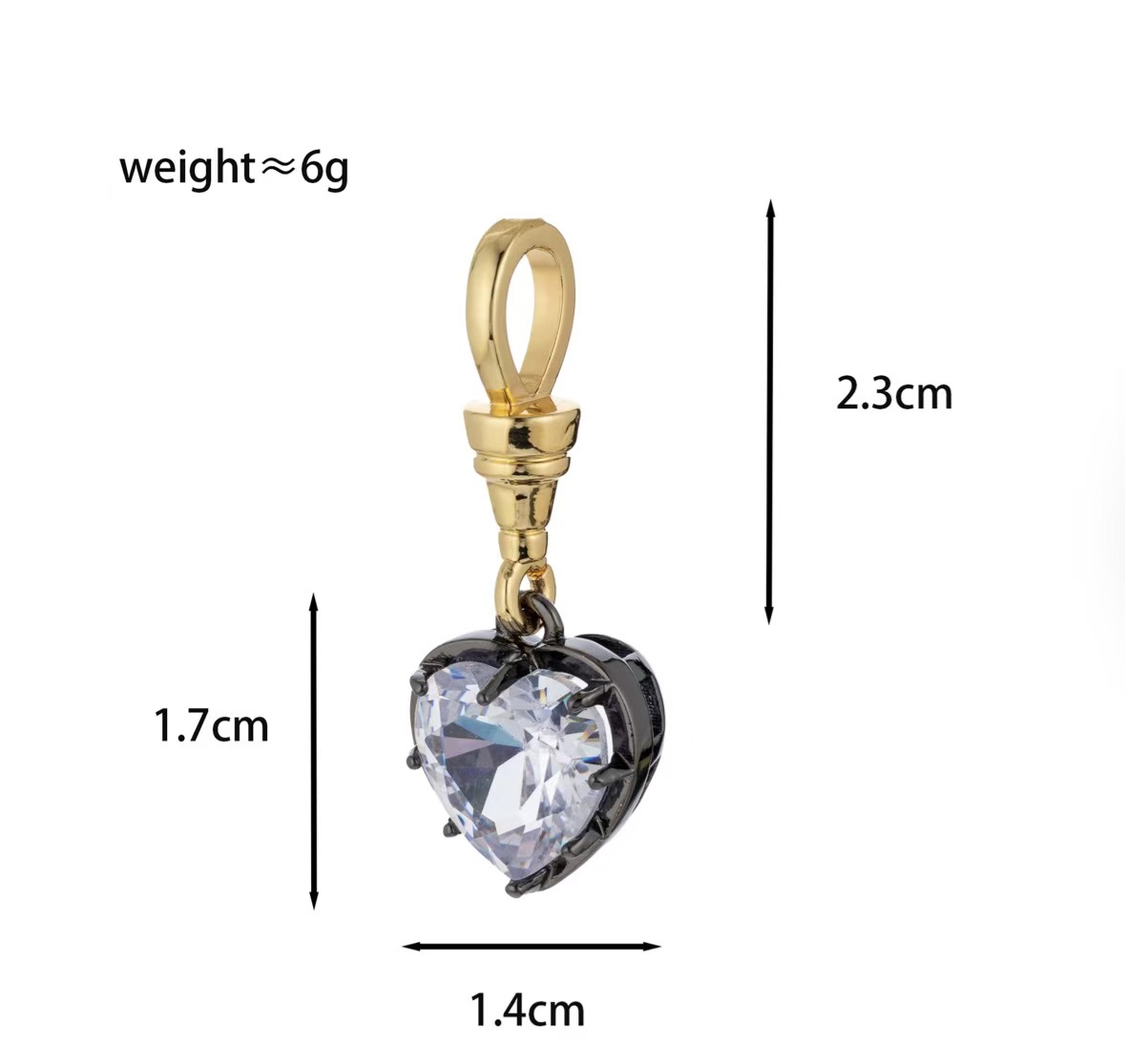
The selected pendant specifications include a heart reference labelled approximately 6 g, with a heart section 1.7 cm high by 1.4 cm wide and an upper clasp section labelled 2.3 cm. These are separate measurements, not an overall-length statement. The image does not specify a usable clasp opening or establish that a particular chain will fit.
Review Weight, Movement and Finish Together
Ask for the weight of the supplied configuration, including the fitting and any connecting parts. Describe the intended movement: freely hanging, limited movement or fixed positioning. During sample review, check how the combined product sits and whether the pendant touches another surface. A weight figure alone does not establish comfort, retention or a load rating.
Specify the required base material and finish for each visible component. A gold-plated copper product description does not define the decorative insert, every separate fitting, coating thickness or test performance. Ask which components the material statement covers and whether finish matching needs an approved reference. Do not infer these details from photographs.
Approve an Assembled Sample
Review the pendant on the intended receiving accessory, not just as a loose piece. Keep an identified sample, the matching specification and a record of requested changes. Check the selected silhouette, connection clearance, orientation, edge condition and the operation of any removable fitting. Record what was reviewed and what remains unresolved.
If your project requires retention, repeated-operation or other testing, agree the method, conditions and acceptance criteria before approval. Request a result that identifies the actual sample and configuration. This guide sets no universal force threshold, cycle count or compliance claim, and a product photograph is not a passed test.
Send an Attachment-Ready RFQ
- Selected pendant reference and images of the receiving accessory.
- Standalone or component application; removable or fixed connection.
- Overall and component dimensions, usable opening and units.
- Target weight, material and finish requirements for each part.
- Assembly responsibility and which chain, ring or clasp must be supplied.
- Quantity by design and color, packaging, destination and requested timing.
- Required sample checks, testing requirements and approval contact.
State whether the quote covers the pendant alone or a complete assembly. Ask how pieces will be separated and protected in the pack, especially when multiple components are supplied. The packaging checklist can help structure the brief; it does not set pendant packaging terms.
Pendant MOQ, sampling, tooling and production timing remain project-dependent. A published stock count is not an MOQ or a reservation. Use the Custom & OEM pendant review to confirm the proposed route and commercial scope.
Pendant Attachment Buyer FAQ
What measurements should I send for a pendant connection?
Send the pendant dimensions, the usable inner opening, and the width and thickness of the receiving part. Identify each measurement and its units on a photo or drawing. Include the intended assembly so the supplier can review clearance and orientation, rather than assuming the external fitting size equals its usable opening.
Does a clasp photograph prove that my chain will fit?
No. A photograph usually does not establish the usable opening or the dimensions of your chain or receiving loop. Send both components or their dimensioned drawings. Confirm the fitting on an assembled sample before treating the connection as approved.
Should I request a removable or fixed pendant attachment?
Base the request on how the finished product will be used. If the wearer needs to swap the pendant, ask for a removable route and review its operation. If the pendant should remain in one position, submit that requirement for a fixed-connection review. Feasibility and testing remain project-specific.
What should the attachment sample approval record include?
Record the sample identifier, receiving accessory, agreed dimensions, supplied components, review date, requested changes and approval status. Where testing is required, retain the agreed method, acceptance criteria and matching result. Do not label a sample as tested merely because an assembled photograph is available.
Request a Pendant Attachment Review
Browse pendant and charm options, identify your intended connection, and send the pendant and receiving-part references together.
Send Your Pendant Attachment Brief